SART Strategy Wheel
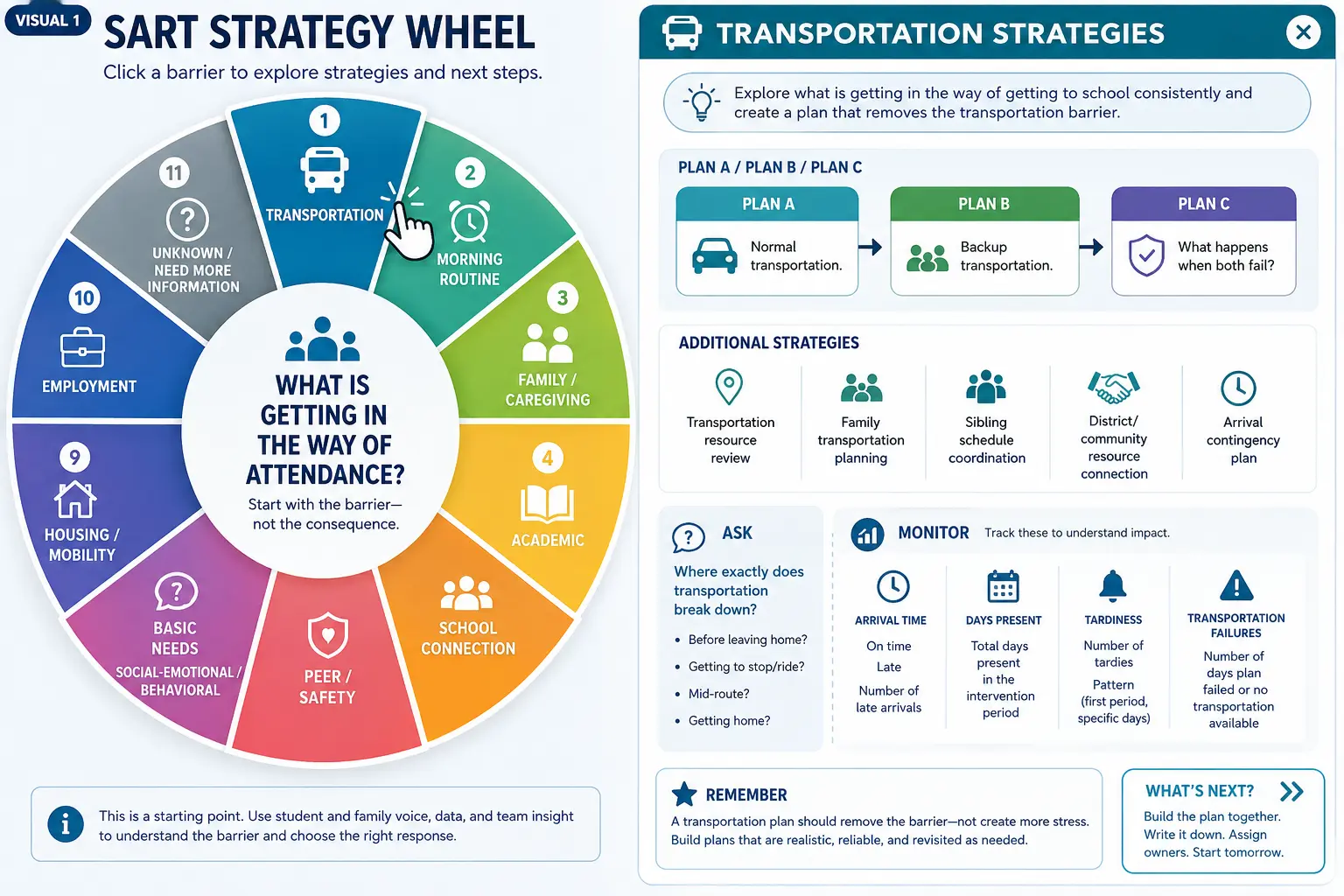
What is getting in the way of attendance?
Opening a SART or team conversation by naming the barrier before choosing a response. Includes Unknown / need more information as a valid option.
Choose what fits your team
Every site and team works a little differently. Pick the visuals that fit how your team plans, meets, and problem-solves — use one, use several, or build a packet. Fill any template in online and export it to PDF or Word, or download the print version for 11×17 or letter (landscape) and fill it in by hand.
No required sequence.
What is getting in the way of attendance?
Opening a SART or team conversation by naming the barrier before choosing a response. Includes Unknown / need more information as a valid option.
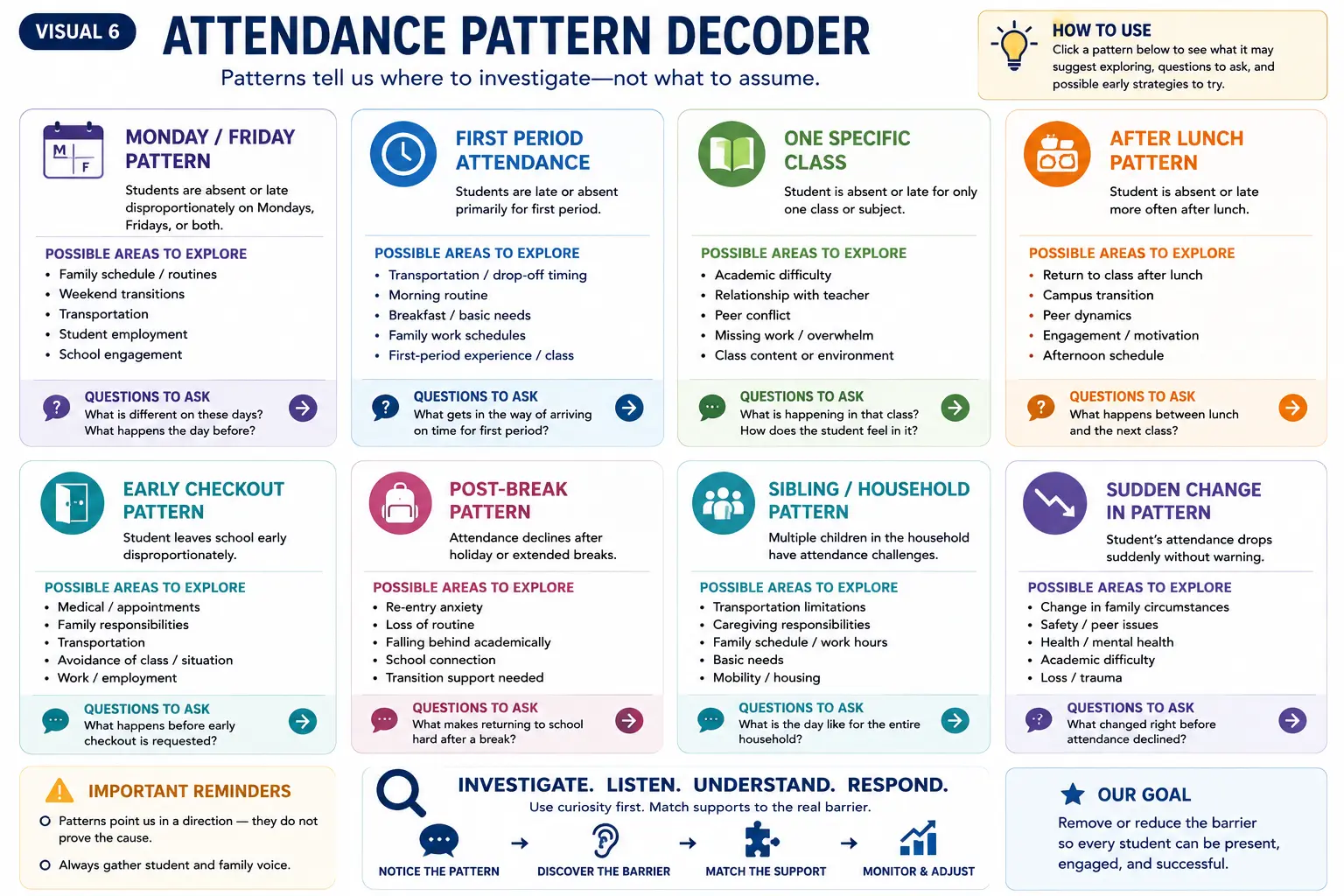
Patterns tell us where to investigate — not what to assume.
Reading Monday/Friday, first-period, one-class, post-break, sibling, and sudden-change patterns with questions to ask for each.
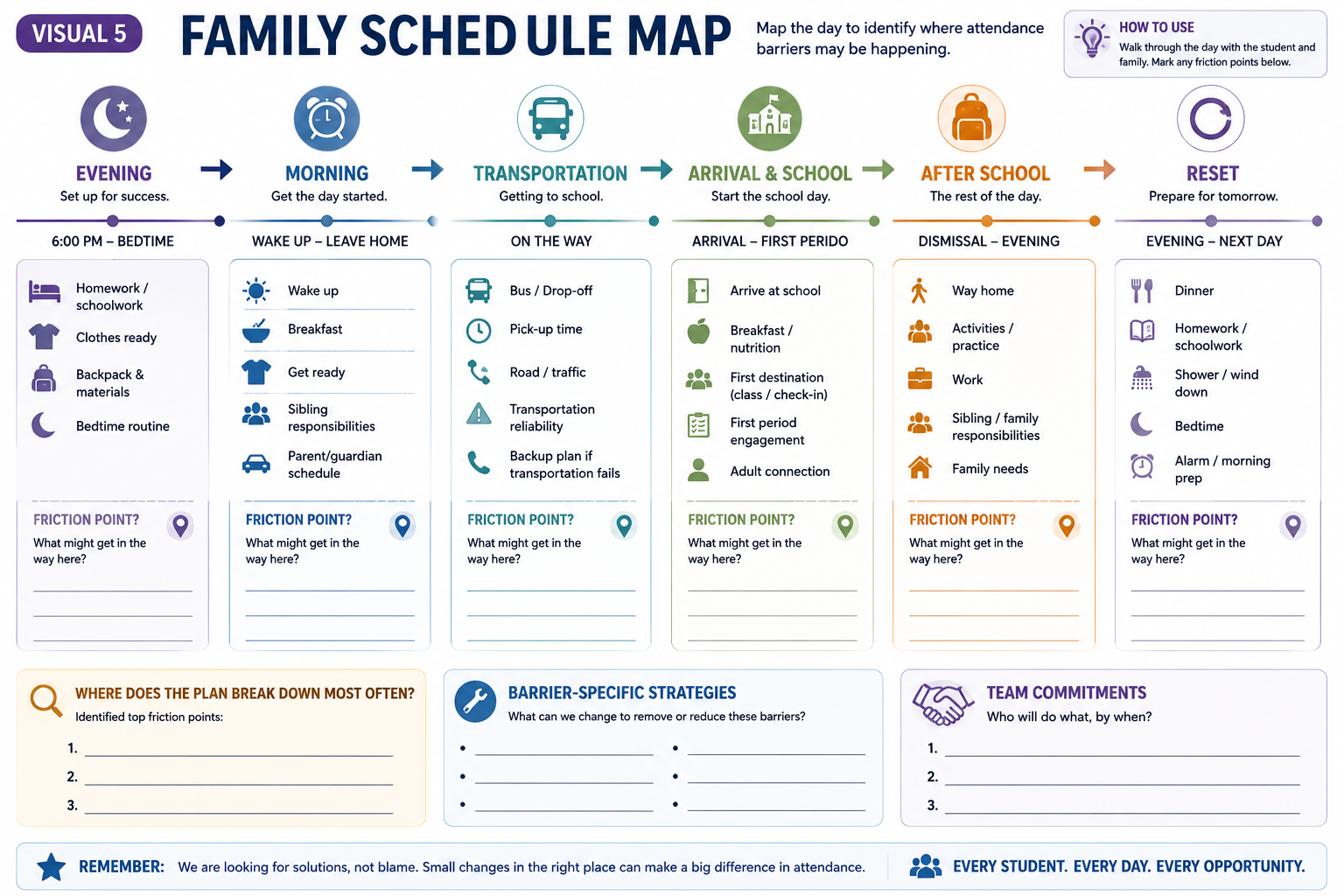
Map the day to find where the barrier actually happens.
Walking evening → morning → transportation → arrival → after school → reset with a family and marking friction points.
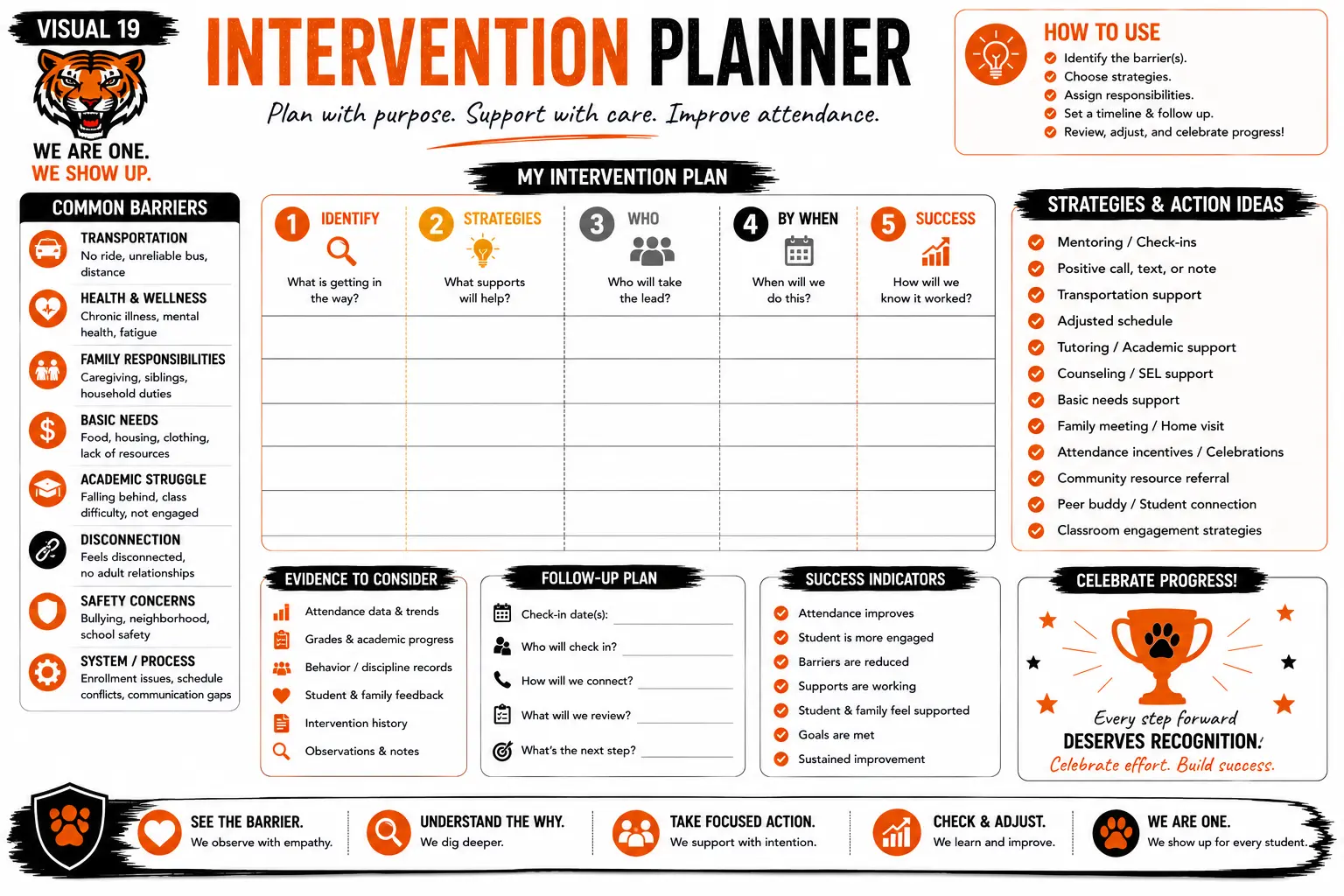
Plan with purpose. Support with care. Improve attendance.
A single-page plan: identify, strategies, who, by when, and how we will know it worked — plus follow-up and success indicators.
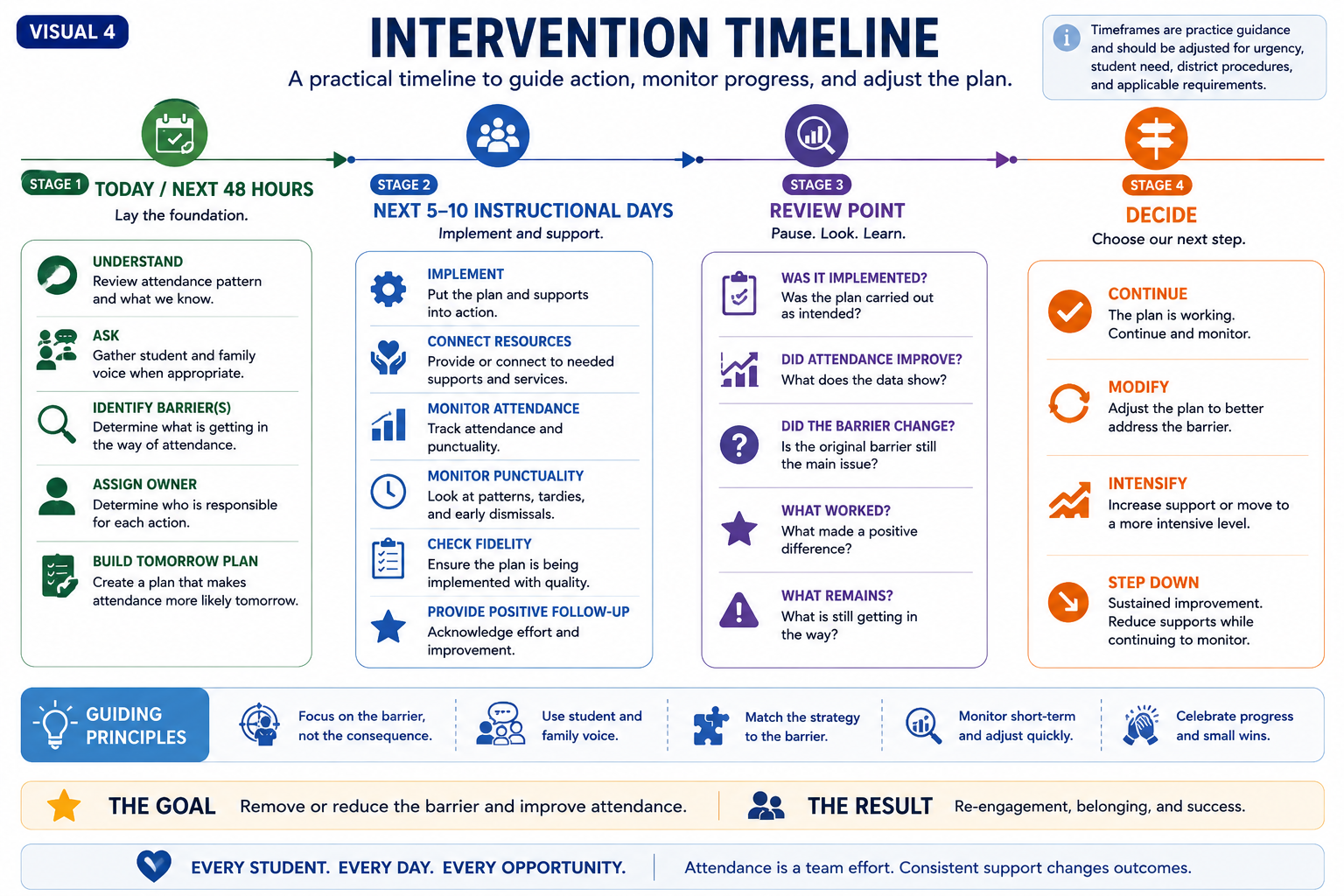
Today / 48 hours → 5–10 instructional days → review → decide.
Setting the short cycle up front so the review point and the continue / modify / intensify / step-down decision are planned, not improvised.
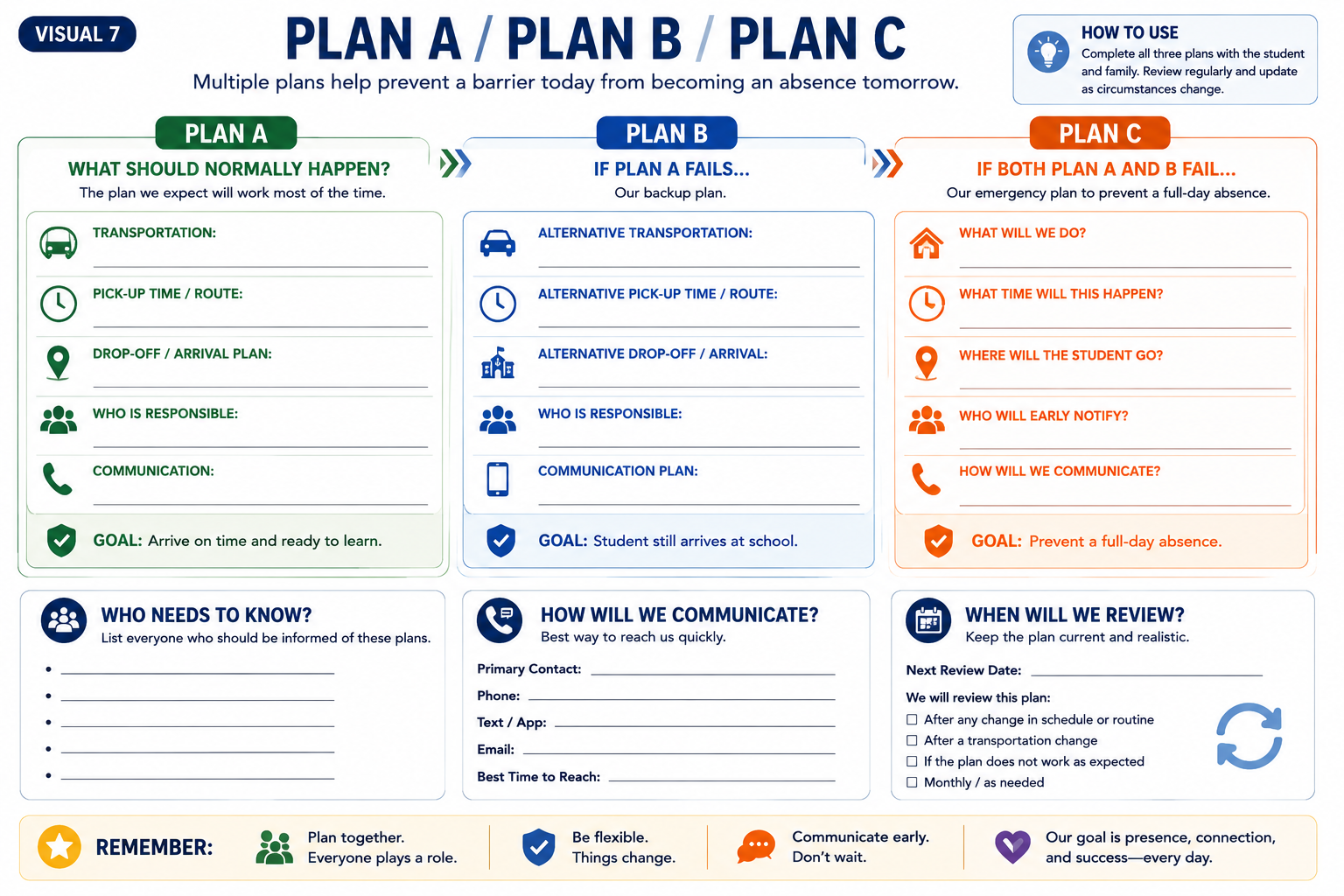
Keep a barrier today from becoming an absence tomorrow.
Transportation and morning-routine barriers: the normal plan, the backup, and the emergency plan that still prevents a full-day absence.
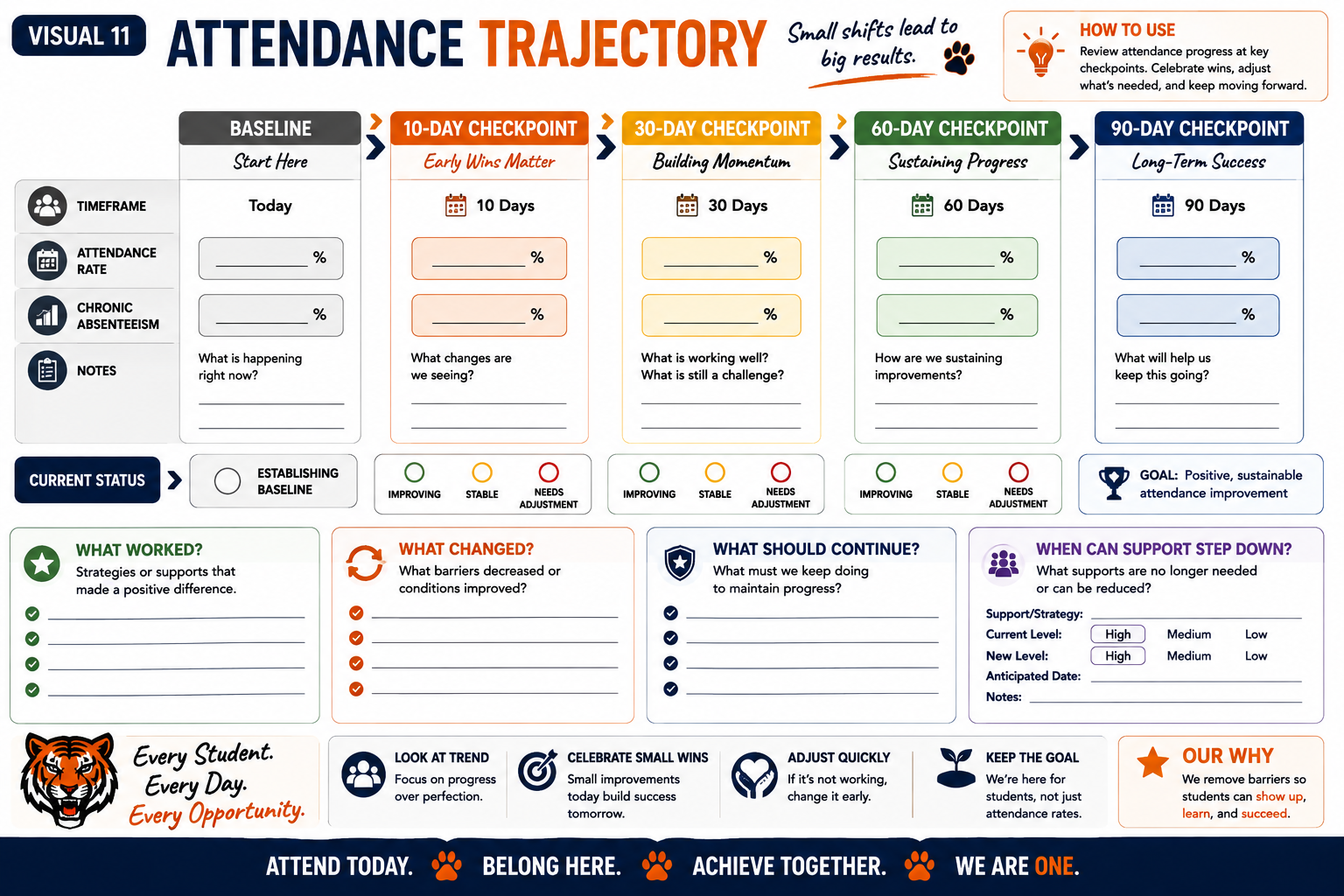
Small shifts lead to big results.
Progress monitoring at 10 / 30 / 60 / 90-day checkpoints: track attendance rate and chronic absenteeism against baseline, capture what worked and what changed, and plan when support can step down.
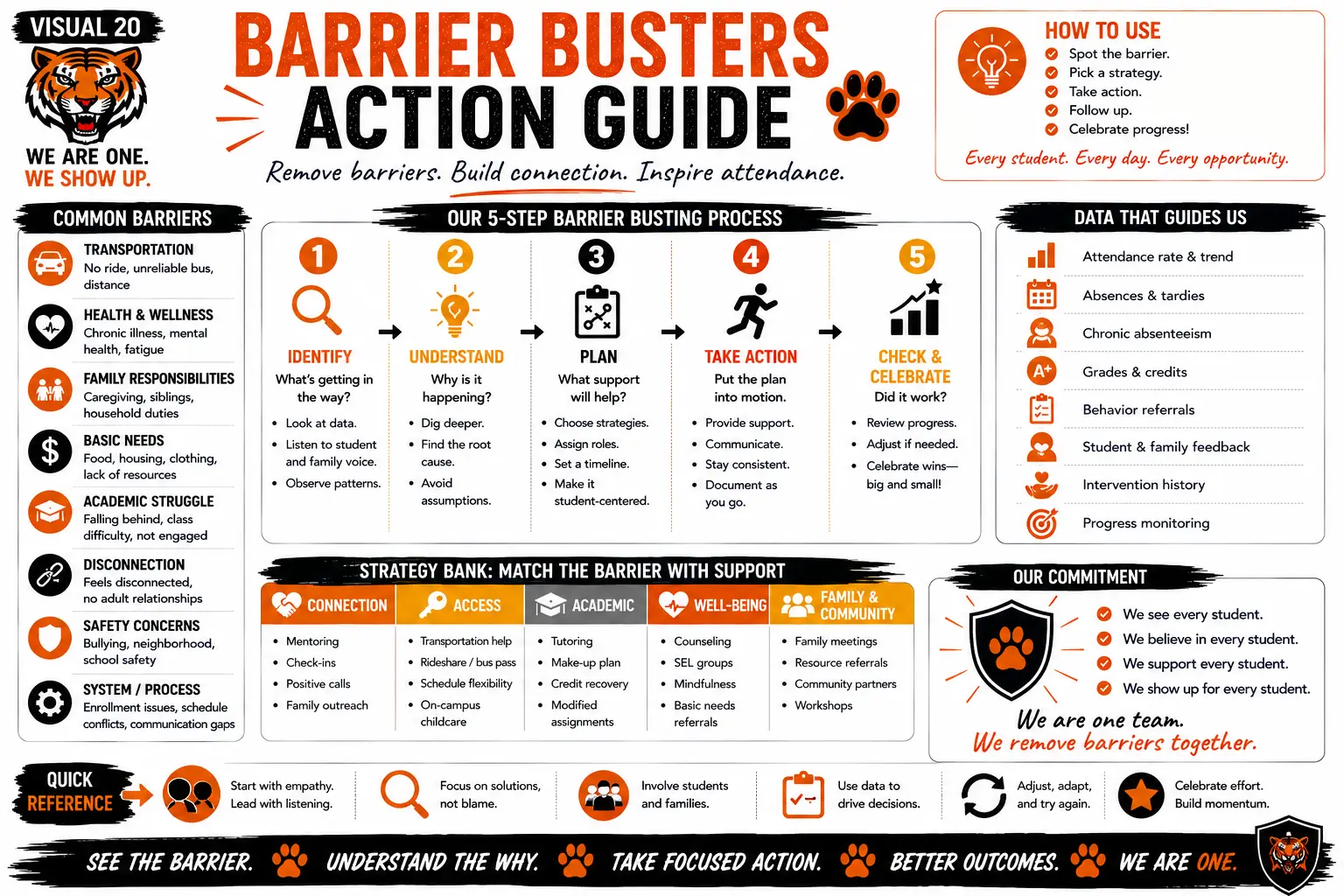
Remove barriers. Build connection. Inspire attendance.
A one-page staff reference: common barriers, the five-step process, and a strategy bank matched to each barrier type.
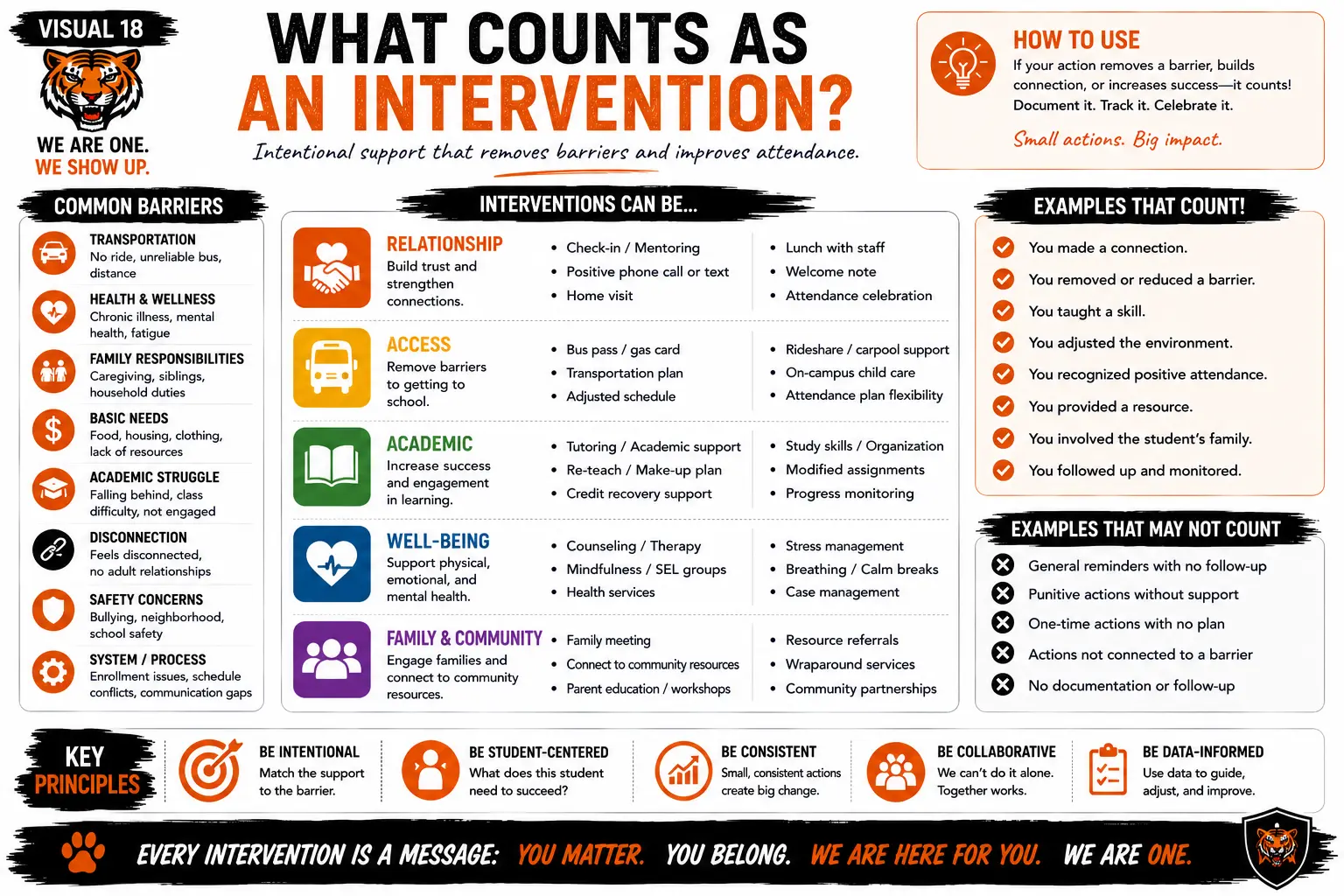
Intentional support that removes barriers and improves attendance.
Teaching the difference between notification and intervention, with examples that count and examples that may not.
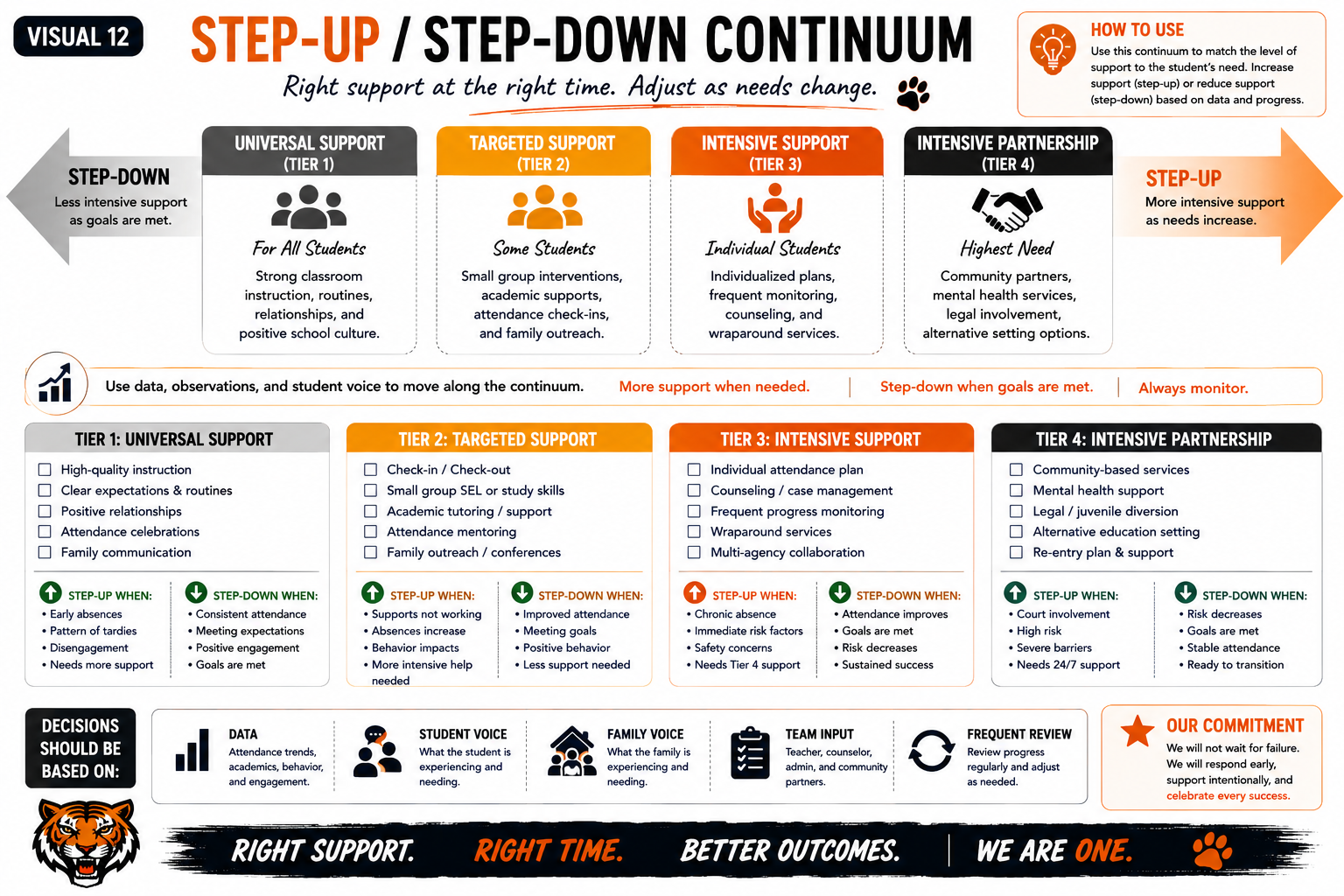
Right support at the right time. Adjust as needs change.
Matching the level of support to the student's need across Tier 1–4, with explicit step-up and step-down criteria for each tier so decisions are based on data, student voice, and family voice.
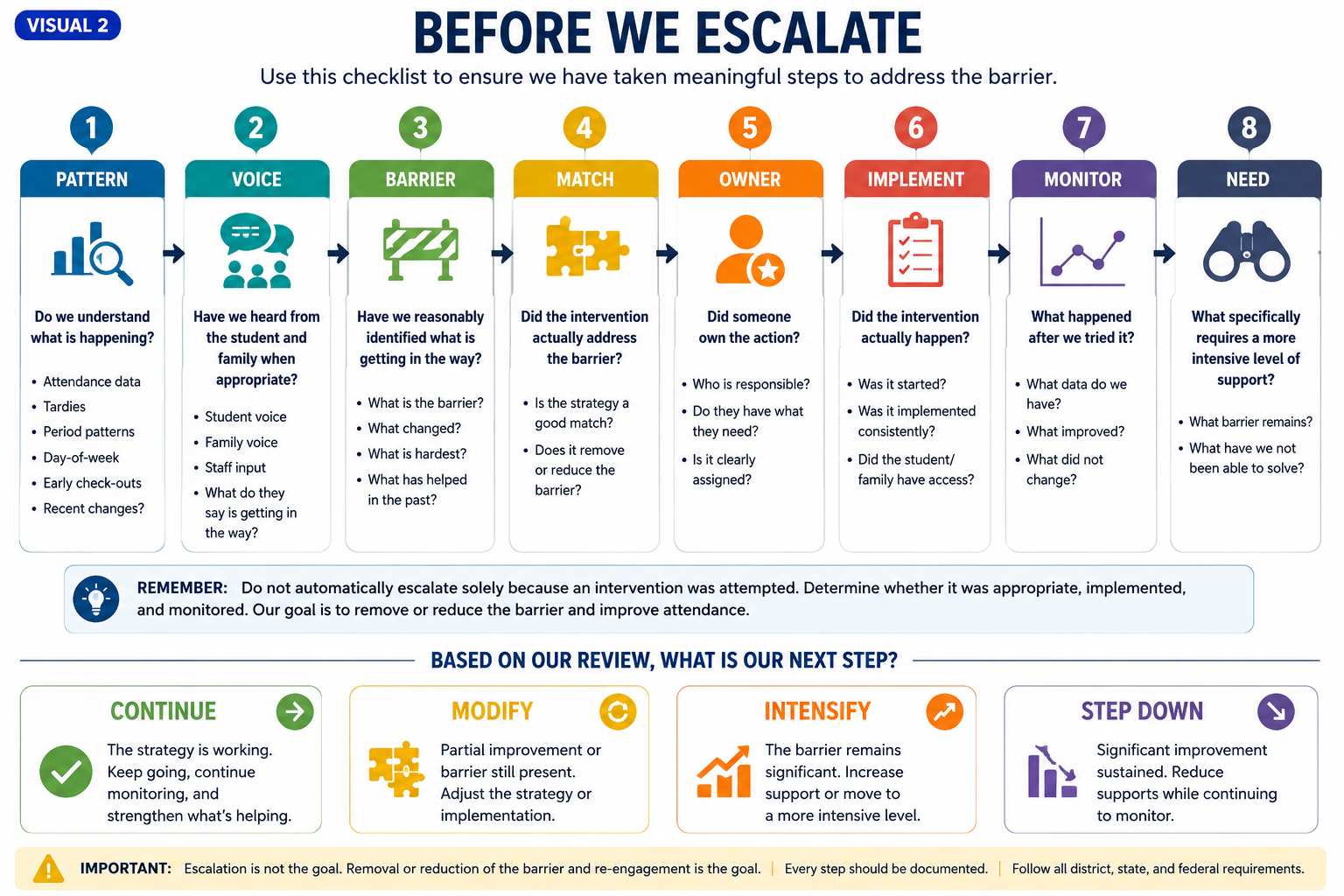
Pattern • Voice • Barrier • Match • Owner • Implement • Monitor • Need
The pre-SARB and pre-escalation review: did we do meaningful work, and what specifically requires a more intensive level of support?
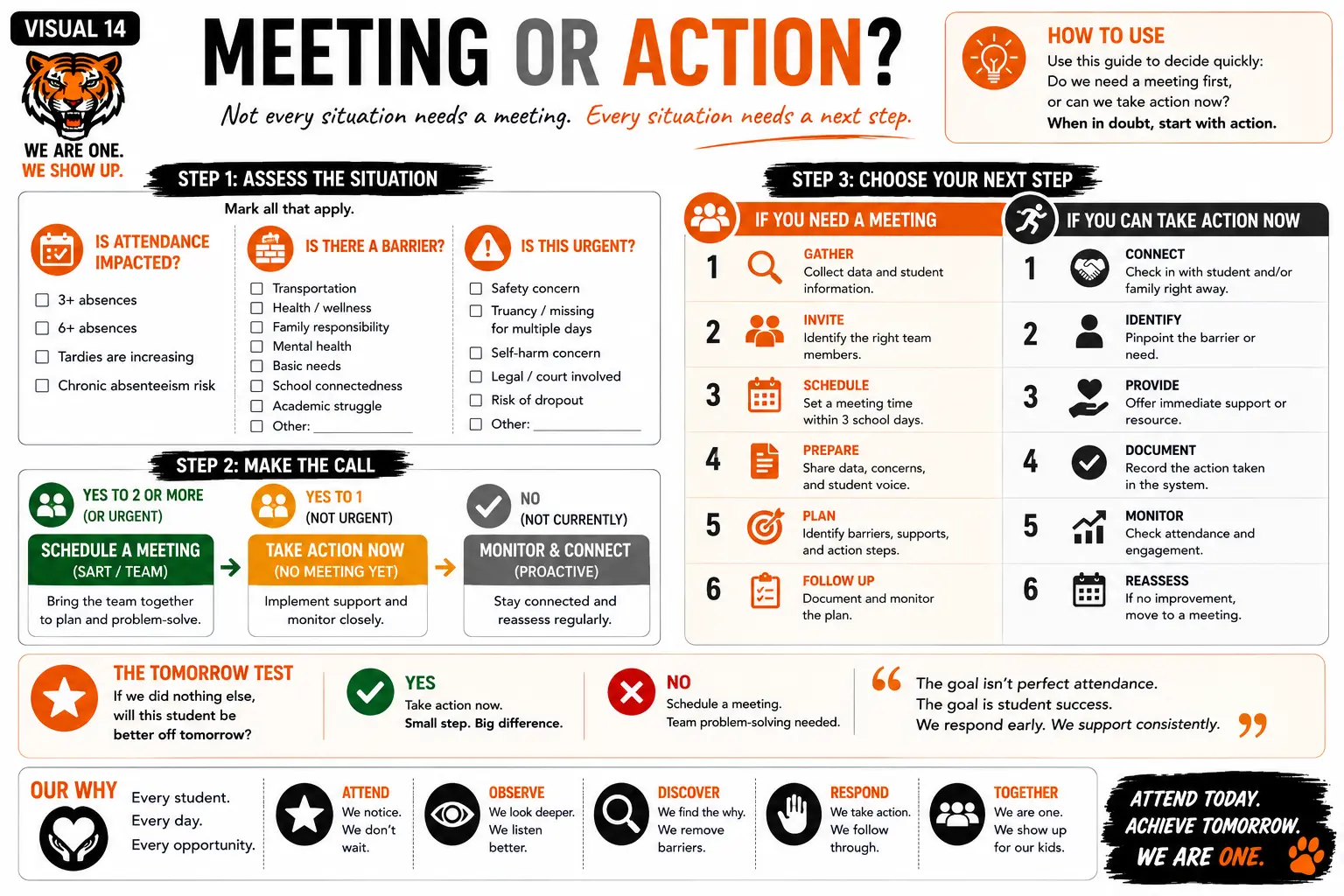
Not every situation needs a meeting. Every situation needs a next step.
Deciding quickly whether to convene a team or act today, with a six-step path for each choice.
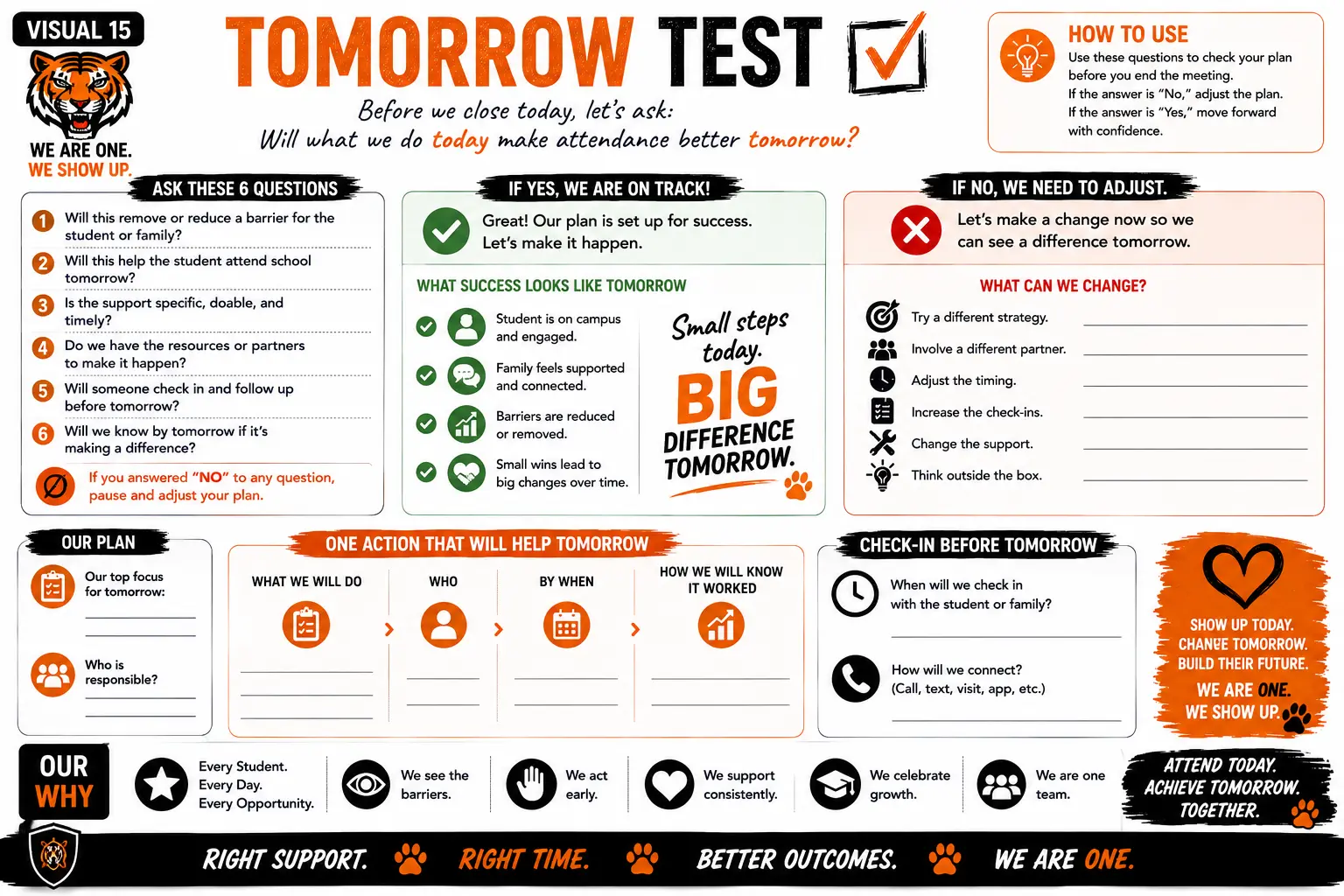
Will what we do today make attendance better tomorrow?
Closing any meeting: six questions, one action, an owner, and a check-in before tomorrow.
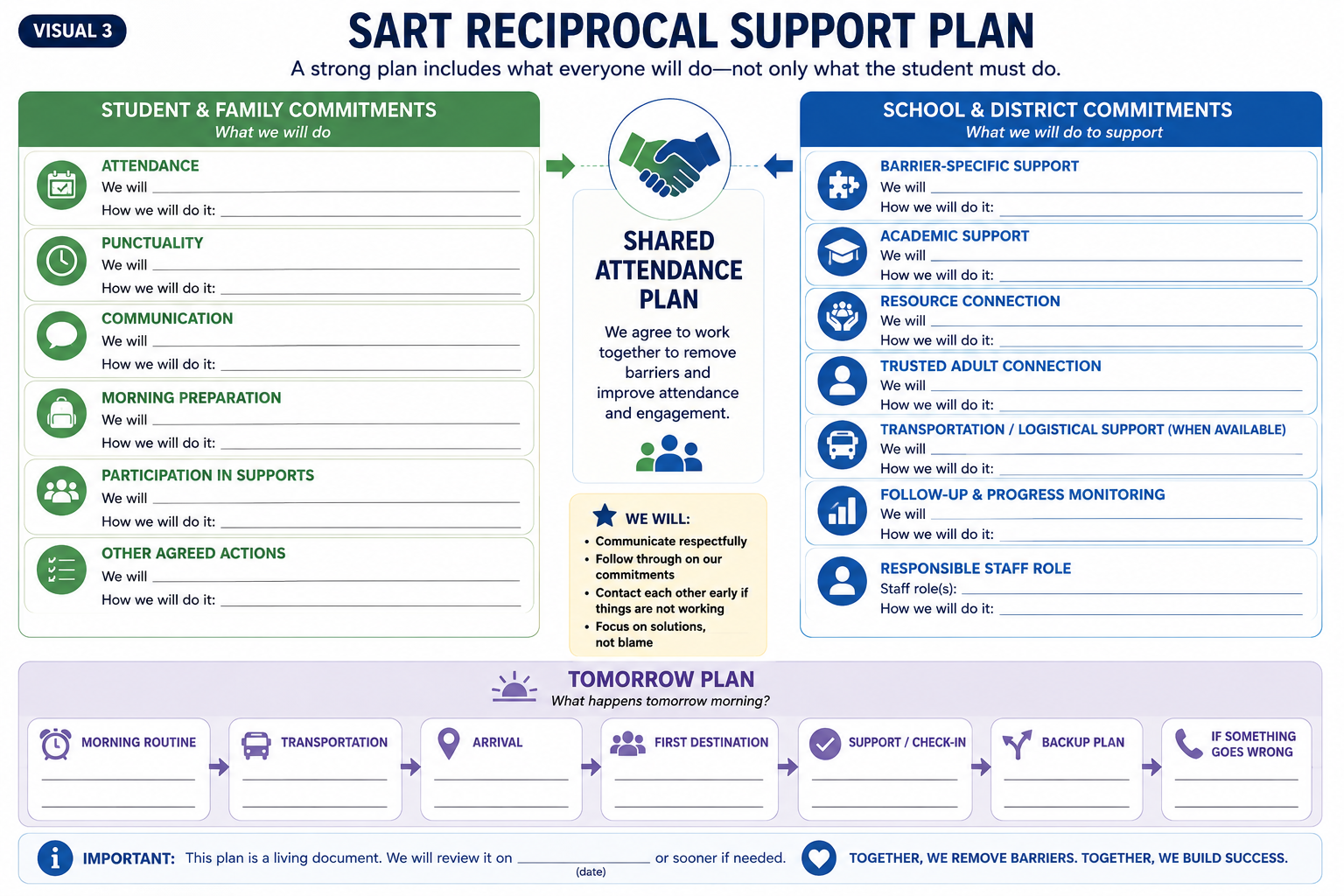
A strong plan includes what everyone will do — not only the student.
SART agreements that pair student and family commitments with school and district commitments, plus a tomorrow-morning plan.
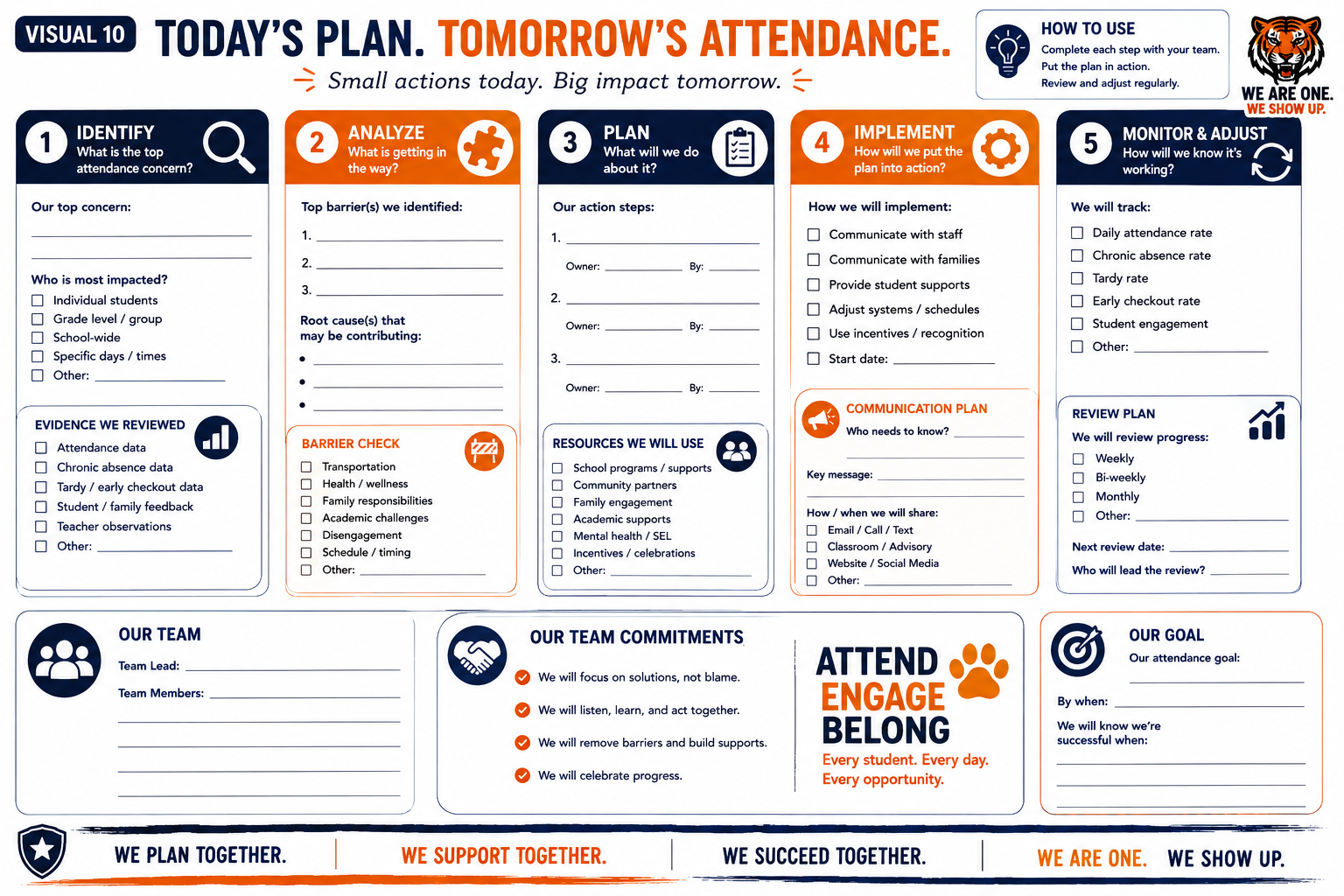
Identify • Analyze • Plan • Implement • Monitor & Adjust
A team planning board for a site-level attendance concern, including a communication plan and team commitments.
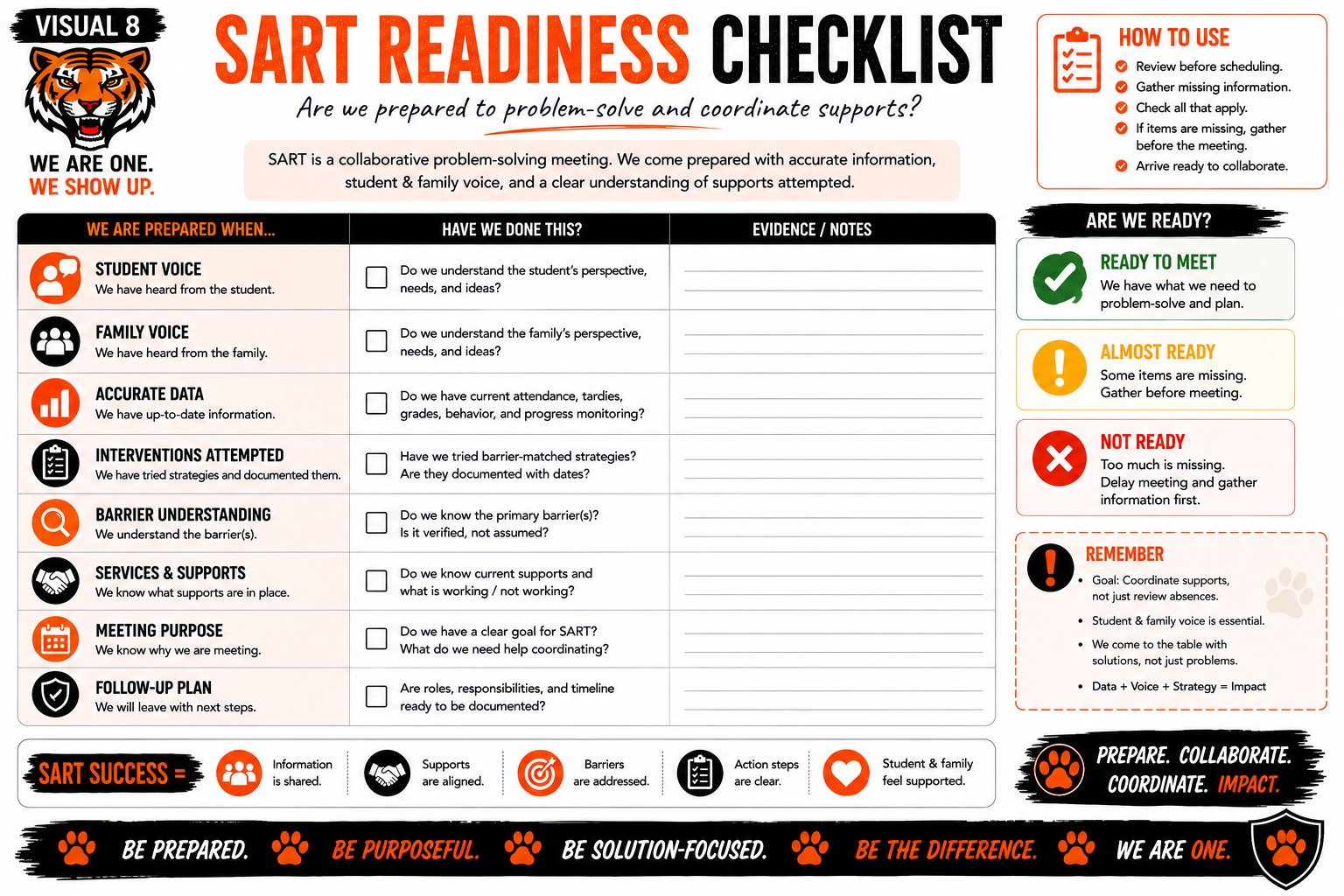
Are we prepared to problem-solve and coordinate supports?
Reviewing before you schedule a SART: student voice, family voice, accurate data, interventions attempted, barrier understanding, supports in place, meeting purpose, and follow-up plan — with ready / almost ready / not ready guidance.
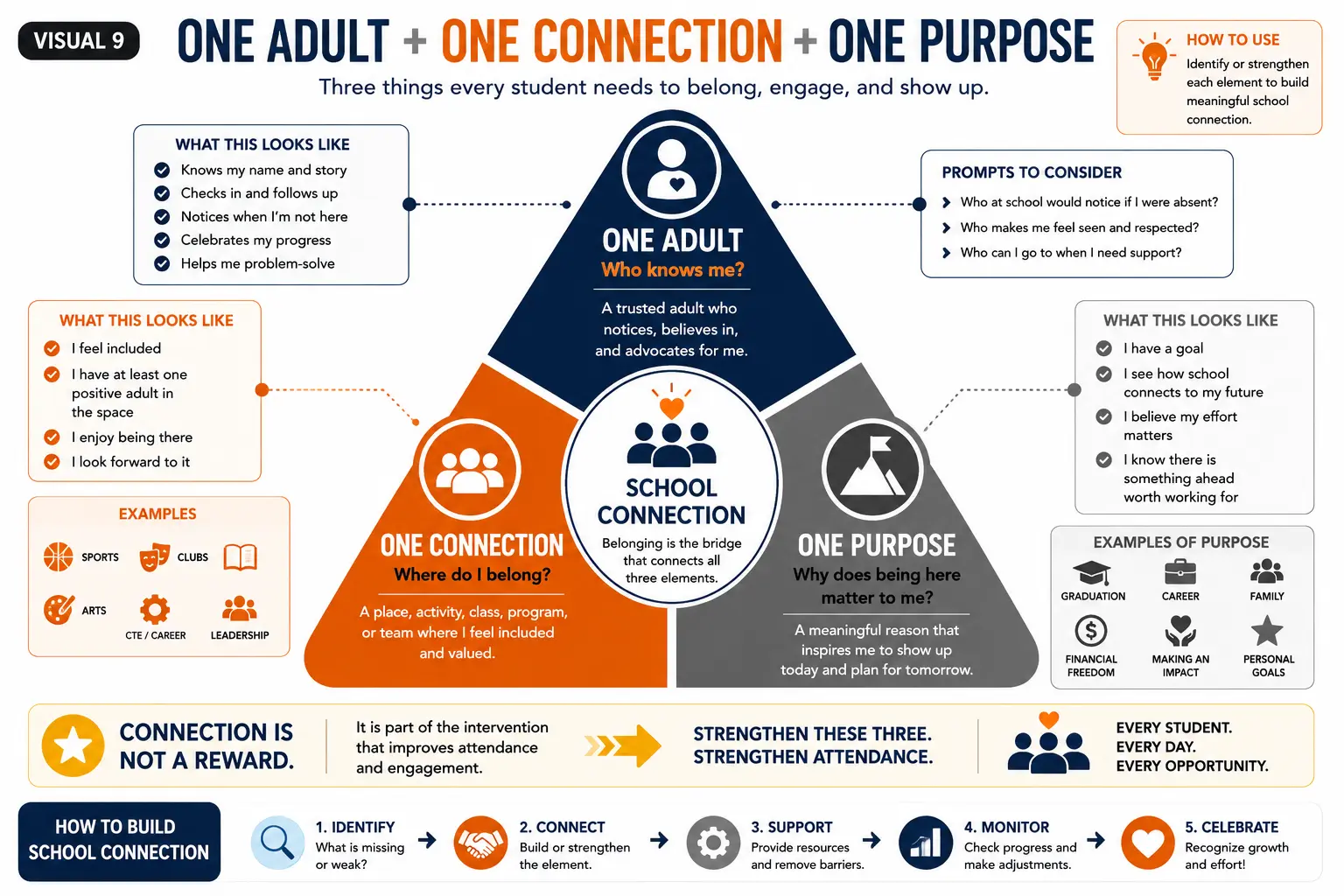
Three things every student needs to belong, engage, and show up.
Checking whether a student has a trusted adult, a place they belong, and a reason to show up. Connection is not a reward.
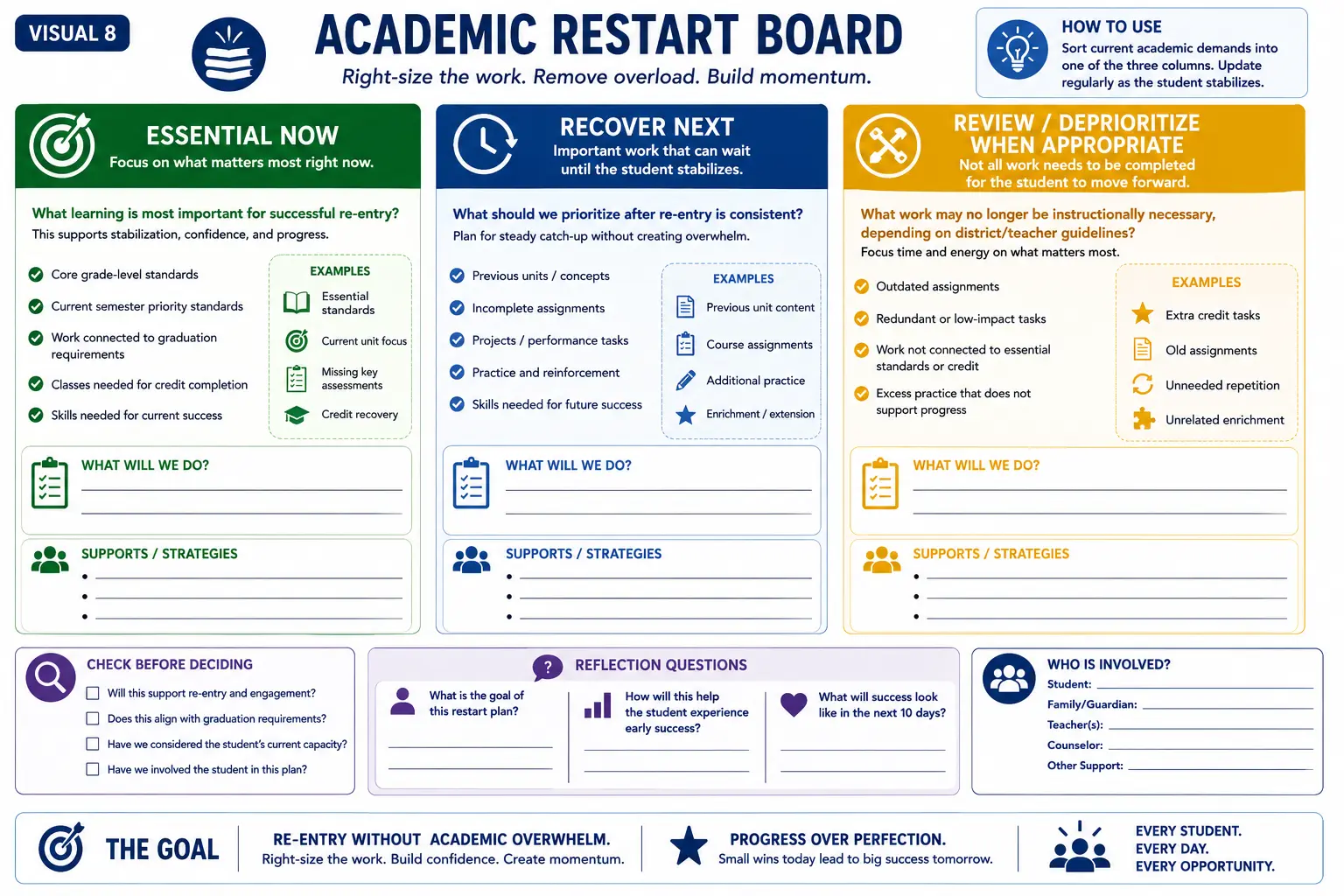
Right-size the work. Remove overload. Build momentum.
Re-entry after extended absence: sorting work into essential now, recover next, and review/deprioritize when appropriate.
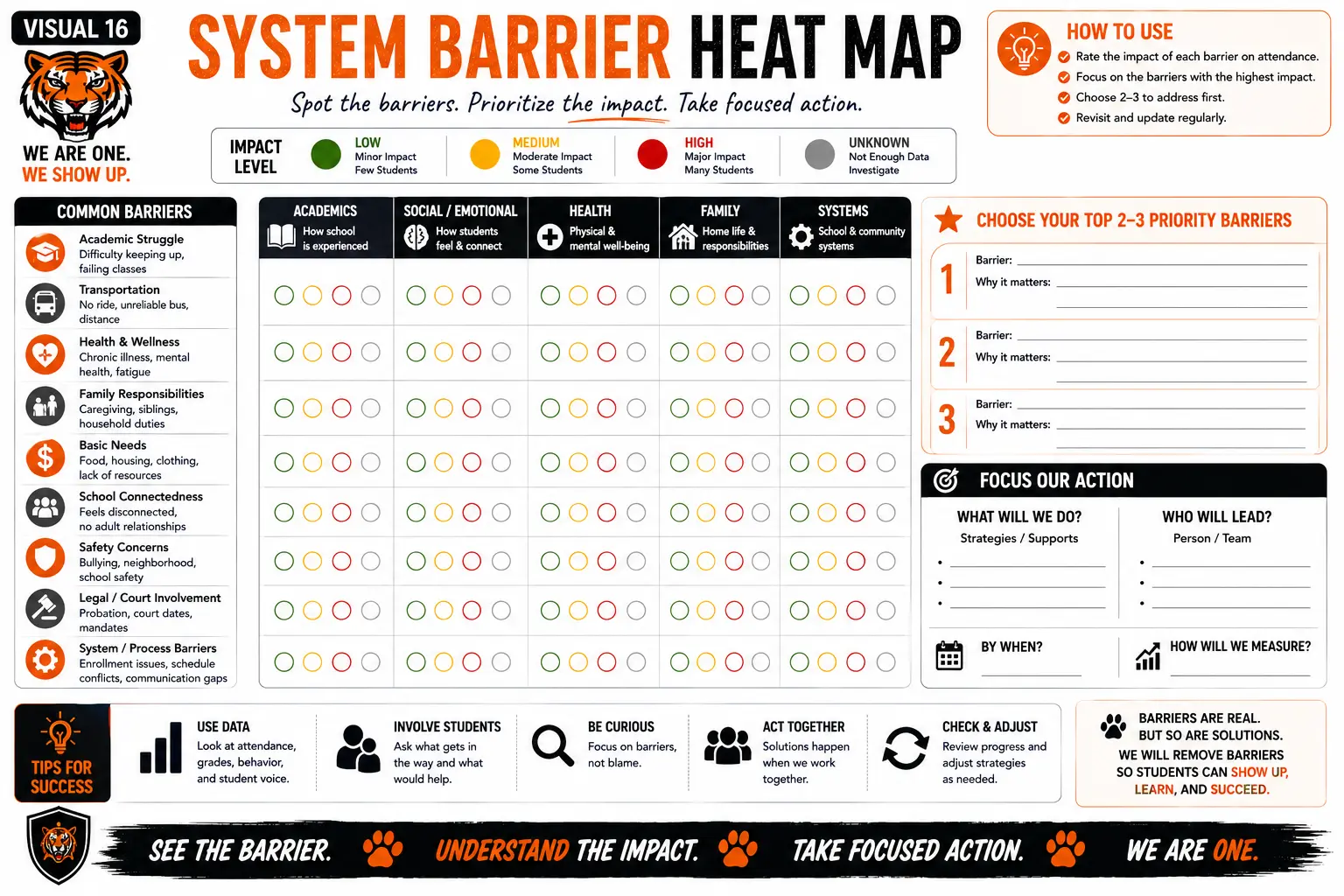
Spot the barriers. Prioritize the impact. Take focused action.
Site teams rating barrier impact across academics, social/emotional, health, family, and systems — then choosing 2–3 priorities.
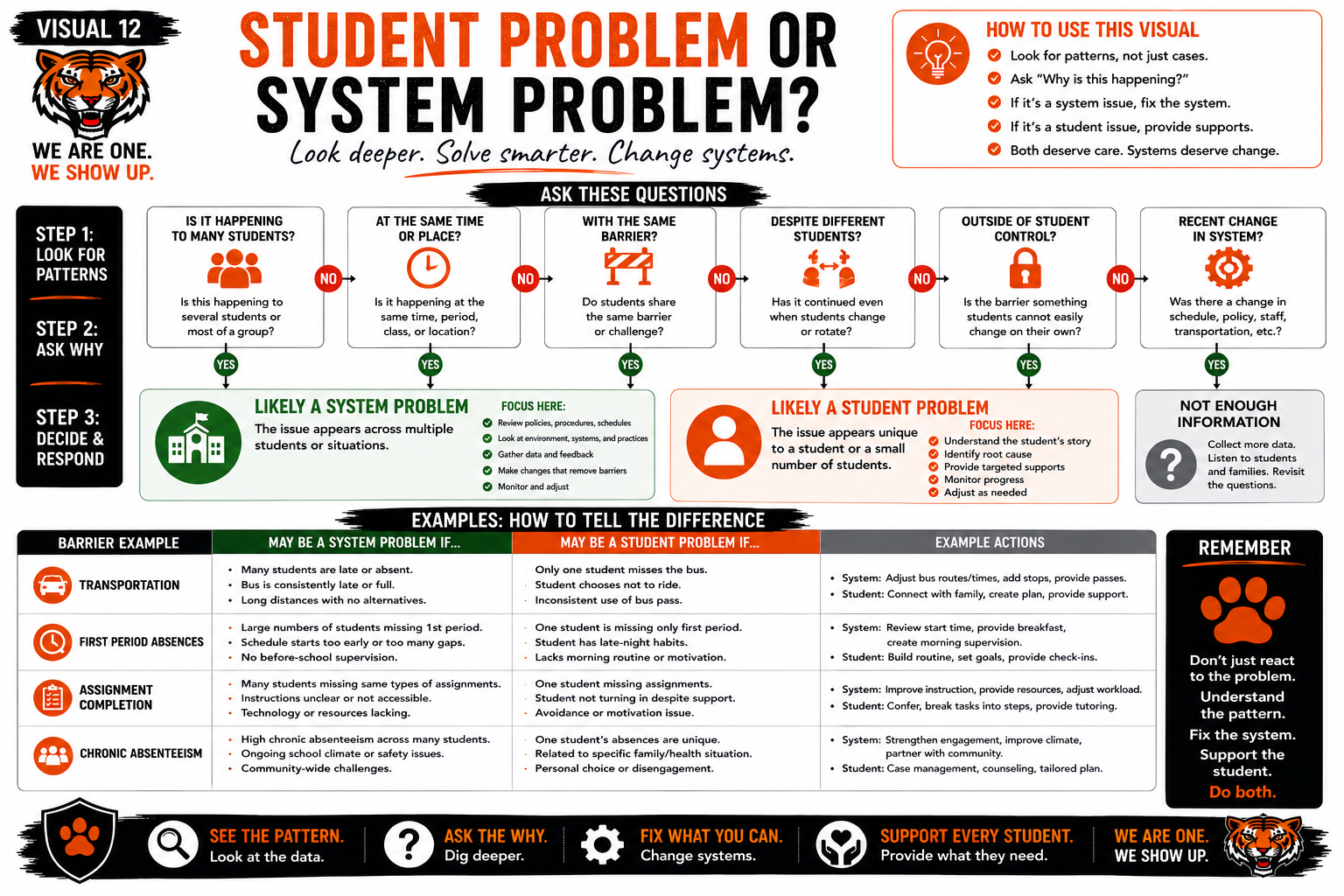
Look deeper. Solve smarter. Change systems.
Deciding whether a barrier is a system issue or a student issue: six pattern questions, then focused actions for each answer, with side-by-side examples for transportation, first period, assignment completion, and chronic absenteeism.
The WUSD SART meeting protocol we use.
Reason for meeting, attendance summary review, student and parent survey questions, academic progress review, supportive measures to implement, and the two-week / four-week follow-up schedule. Fill it in online and export to PDF or Word.